Sunday, August 17, 2025

The Upgrade Files: Case 04 – Defensive Retrofits

Defensive Retrofits are — alongside Weapons Teams and Officers — among the top three upgrade slots. Whether it’s keeping your brace alive, stopping a crucial die from rolling, or shaving damage off the top, the upgrades here often decide whether a ship survives and gets to take one more turn.

Because of that, competition is fierce. Almost every ship with access to this slot is married to one of a handful of powerful cards, leaving the rest in relative obscurity. Let’s start with some of the more overlooked options.


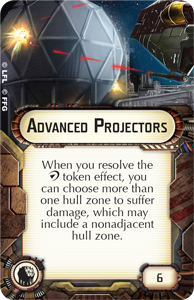
Advanced Projectors

You don’t see these often, but not because they’re bad. Quite the opposite: they’re excellent if you’re running a double-redirect ship without a brace. In practice, that basically means the MC30 and the Imperial Arquitens. On the MC30 they can be brilliant; on the Arq, at 6 points, harder to justify.

You can also throw them on the MC80 Assault as a second Defensive Retro, but post–1.5 that’s mostly redundant. Without the looming threat of a triple-tap Demolisher with ACMs, most players will just take Early Warning Systems instead.

And ships with braces? Forget it — they’ll 100% choose ECM or Thermal Shields every time, because getting to use that brace at the right moment is one of the biggest pivot points in Armada. That’s not a flaw of the card, but of the underlying rules design.

Verdict: A good upgrade limited by its available platforms and outshone by ECM/Thermals. Could probably drop to 5 points — it doesn’t actually stop damage, and it blocks Expert Shield Techs from being useful anyway.


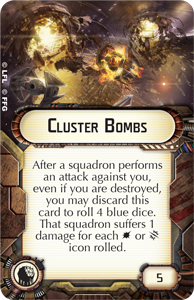
Cluster Bombs

I’ve used these to decent effect on occasion. They’re a strong deterrent against squadrons — cluster bombs plus flak plus your own squadrons can tip the math against enemy squadrons. At 5 points, though, they feel slightly overpriced compared to other defensive retros.

The bigger issue: this is a Defensive Retrofit that only protects one ship. To get real coverage, you’d want it on multiple hulls, and suddenly it becomes very pricey. And 99% of the time you want your Defensive slot for something else. That means Cluster Bombs almost always end up on small ships, sometimes MC30s, but rarely anywhere else.

In many ways, it suffers the same fate as Advanced Projectors: the design of the slot forces medium and large ships into other upgrades.

Verdict: I’d suggest a redesign or moving it to another slot (Offensive Retrofit is the only one that comes to mind). If redesigned, make it able to trigger off squadron attacks against friendly ships at distance 1–2. That would let you throw it on a few small ships to give fleetwide anti-squad protection, instead of just one-off deterrence.


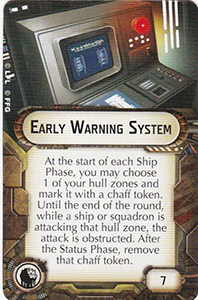
Early Warning System

A solid upgrade on the right hull. Most often seen as the second Defensive Retrofit, but occasionally taken alone. Not because the card is flawed, but because of the ECM/Thermals stranglehold on the slot.

Verdict: Leave as is. It does exactly what it’s supposed to do, and it does it well.


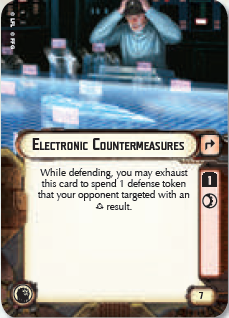
Electronic Countermeasures (ECM)

The gold standard. For every ship that can’t take Thermal Shields, ECM is stapled on almost by default. The bigger and more important the ship, the more likely you’ll see it. Even the nerfed “pay-to-refresh” version is still that good.

Why? Because nothing matters more than getting that brace to work at a key moment. Sure, there are counters — Intel Officer, Overload Pulse (cheaper now but still not great), Sloane, Boarding Troopers — but those just flip tokens. ECM still lets you get that one critical use. And in many games, it’s even more useful than that, allowing you to squeeze value from secondary tokens or just make your opponent's accuracy icons matter a whole lot less.

Unless you rewrite Armada’s core defense-token system, you can’t really “fix” ECM — because in a way, it fixes the system. You could limit it to a few charges per game, but it would still get stapled.

Verdict: The only practical adjustment is cost. At 7 points, it’s already an auto-take; bump it to 8 and it’d still be stapled, but at least you pay a bit more for it.


Reactive Gunnery

Perfectly fine. Extra salvo is always welcome, but it costs a Defensive slot and exhausts. That keeps it balanced, and unsurprisingly it only finds homes on ships that really lean into salvo builds.

Verdict: Leave as is.


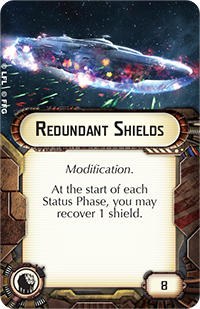
Redundant Shields

Potentially useful, but 8 points plus modification makes it a tough sell. The effect isn’t bad, but the tax is.

Verdict: Keep the modification tag but cut the cost significantly. At 4–5 points, suddenly it’s attractive on small or medium ships that don’t already need their mod slot. At 8, it’s binder fodder.


Reinforced Blast Doors

A perfectly solid card — timing is good, effect is clean, price is reasonable. But it almost never shows up, because the ships that benefit the most (big tanks) are the ones locked into ECM/Thermals.

Verdict: Leave as is. Its problem isn’t power level, it’s slot competition.


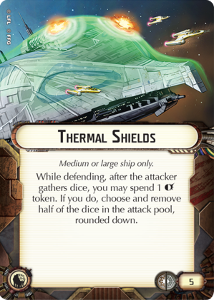
Thermal Shields (GAR/CIS only)

A well-designed card, created to give Clone Wars factions a much-needed defensive edge while also offering counterplay to Intel Officer — which remains a popular tool, so Thermal didn’t invalidate it completely.

The issue? It’s underpriced for what it does. In practice, it’s worth more or less the same as ECM. If ECM is 7, Thermals should be 6; if ECM is 8, Thermals should be 7. The current gap makes it feel like a bargain.


Category Verdict: 

Defensive Retrofits are one of Armada’s most important upgrade categories — arguably the most important. And the problem is clear: everything revolves around being able to leverage a brace at the key moment. That creates an overreliance on ECM or Thermal Shields, and while both cards are excellent, their dominance squeezes out nearly every other option.

The catch is you can’t really nerf ECM or Thermals without destabilising the whole game, because they patch a weakness in the core rules. That means other defensive upgrades will always be fighting uphill for relevance.

Still, there’s space for small fixes — trimming costs on underplayed cards, nudging overpriced deterrents like Cluster Bombs, and considering redesigns for upgrades locked into the wrong slot (Cluster Bombs and PD Reroute come to mind). But fundamentally, this slot is shaped by ECM and Thermals, and unless the defense token system itself changes, that won’t shift.


Next Up: 

Support Teams — the slot of nav tricks, engine techs, and a few oddballs. Some are staples, some are long-forgotten, and one or two could probably have been designed as ship titles instead.

Saturday, August 16, 2025

The Upgrade Files: Case 03 – Offensive Retrofits

If Weapons Teams are prized and Defensive Retrofits are precious, then Offensive Retrofits are… the grab bag. This slot is where FFG/AMG tossed in all sorts of odds and ends: squadron toys, gimmicks, and a few powerhouse effects. Some are staples, some are pure binder fodder, and some are cards you wish had never been designed in the first place.

Let’s go through them one by one.


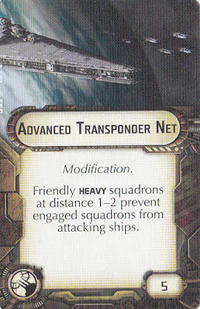
Advanced Transponder Net

Useless. This was made with pre-nerf Intel in mind, but once Intel got smashed to bits, ATN became not just binder fodder but full trash compactor food. Yes, you can dream up some corner-case scenario where it does something, but realistically: no. And it’s a modification, too. Hard pass.


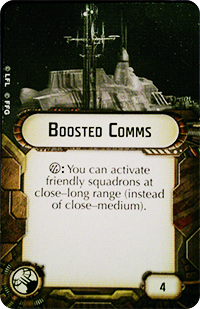
Boosted Comms

A strong effect that’s been around since Wave 2. It detaches squadrons from their carriers by extending command range, which typically favors fast squadrons the most. At 4 points, it’s fine, though it looks pretty cheap next to Expanded Hangar Bay at 5. Probably deserves to be 5 or even 6 points.

If Armada had universal ship keywords, this card would probably be “Comms Ship only,” but in practice, that’s already where it lands. A classic that still works.


Disposable Capacitors

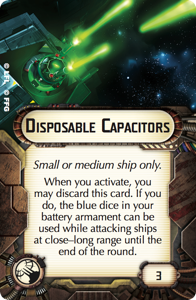
Good card, modestly priced at 3 points even as a one-shot effect. It was created specifically to prop up struggling ships (Raider-II, Victory-II, etc.), and in that context, it works.

But that’s exactly the design issue: ships shouldn’t need band-aid upgrades to function. Every new small/medium ship design has to account for the existence of this card. In an ideal world, the reliant hulls would get a cost drop, and DCaps would creep up a point.


Expanded Hangar Bay

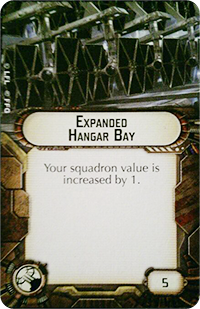
Perfectly useful, perfectly costed. Nothing to see here — move along.


Flag Bridge

A great little design: medium or large flagship only, modification, but free and grants a Fleet Command slot. Zero cost for high flexibility, offset by strong restrictions. Leave it exactly as it is.


Flak Guns

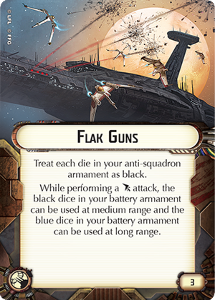
They do their job, the cost is right, no fuss. Leave as-is.


Hardened Bulkheads

A weird one. At 5 points and limited to large ships, it’s rarely seen. Why not mediums too? The effect itself is fine, but the size restriction makes it awkward. Drop to 4 points and open it up a little — suddenly it’d see at least some play.


Phylon Q7 Tractor Beams

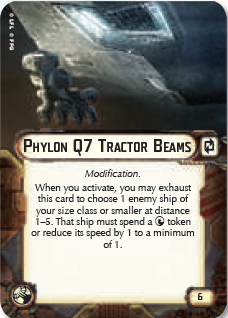
Manipulating enemy movement is powerful but hard to balance — lean too far and you get oppressive NPEs. As-is, Q7s feel maybe not overpriced but certainly clunky. If they worked like the Interdictor’s G8s (exhaust when an enemy moves, but with a refresh cost), they’d be much more useful. A less invasive change would be to drop Modification. 


Point-Defense Reroute

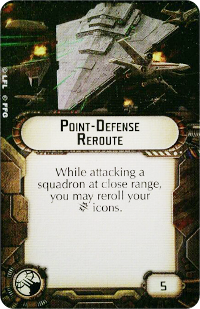
Kind of useless. There are better, cheaper ways to flak. Yes, there are some corner builds where it synergizes with other upgrades, but those are the exception. Either rework it into something meaningful, bin it, or drop it to 2 or 3 points and accept it as binder filler.


Proximity Mines

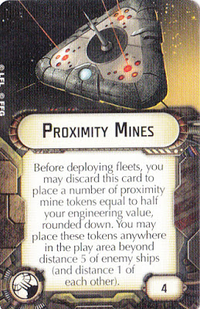
Not sure mines were ever a great idea in Armada, but the card itself works fine. If you’re going to keep mines in the game, this is a fair implementation.


Quad Laser Turrets

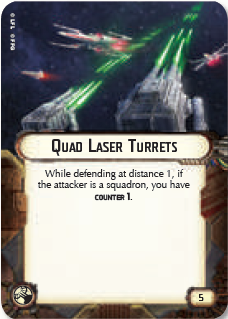
Same problem as Point-Defense Reroute: too marginal, too niche, too expensive for what it does. Rework, bin, or cut to 3 or 4 points.


Rapid Launch Bays

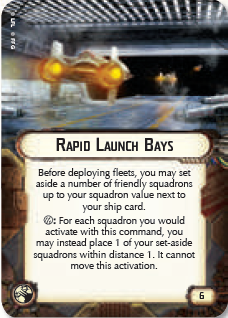
The new version is more balanced but less flexible. No more Flight Commander tricks, but now there’s counterplay and no Squadron dial requirement.

At 6 points, with squads set aside rather than deployed, it feels niche or even overcosted. Not bad, but not common either. One of those cards that looks great in theory and ends up dusty in practice.


Reserve Hangar Deck

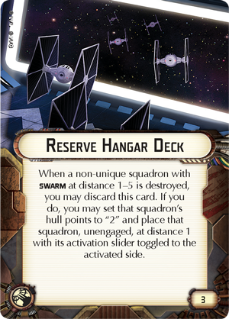
Still a great card. The bump from 3 to 4 points was deserved, even if it hurts generics a bit more. It was usually tied to Tri-fighters and TIE Interceptors anyway, so fine.

The bigger issue is wording: it should clearly say friendly squadron. If it doesn’t, ARC should fix that yesterday. Resurrecting enemy squadrons is just bad design.


Hyperspace Rings (GAR only)

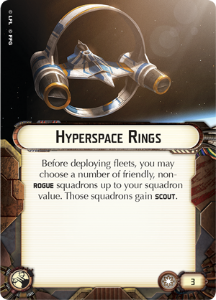
Why, FFG, why? Scout is already a weak keyword, so why tie this to it? As-is, the card is useless.

Better version: squadrons with Scout gain speed 3 (unless they already have higher). That would actually give ARC-170s a neat niche. Right now? Trash compactor.


SPHA-T (GAR only)

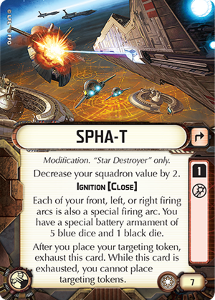
I hate this card — not the design itself, but the way it forced the Venator to be built around it. Look at the Venator dice pools, then at the ARC Imperator variant with no Offensive slot. It’s all because of SPHA-T.

That said, unless you want to redesign the Venator from the ground up, the card has to stay. Within that context, its cost and limitations are correct.


B2 Rocket Troopers (CIS only)

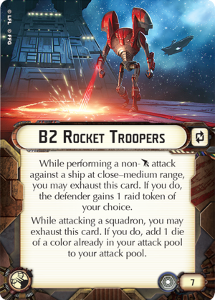
Pretty great — but only with TF's black-dice-on-raid shenanigans. For other CIS fleets, not worth it even with the secondary anti-squad effect. Consider dropping to 6 as the “TF tax” is very much real.


Hyperwave Signal Boost (CIS only)

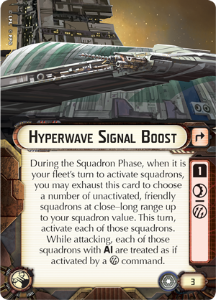
The CIS equivalent of Hyperspace Rings: underwhelming and awkward. It lets you use AI in the Squadron Phase to add dice. You can even “activate” zero squadrons, which technically works and is somehow more useful as a stall tactic than the intended design.

If you're using Legacy content, you could even take Vultures just for stalling so your Rogues go last. I’m 110% sure that wasn’t the intent, but here we are.

How to fix it? Let it fully activate squadrons in the Squadron Phase, but balance it with restrictions (modification, refresh cost, maybe no AI bonus if you move and attack). But that’d be a wall of text on a card. As-is, it’s just bad.


Verdict:
Offensive Retrofits are the ultimate mixed bag. Some are timeless staples (Boosted Comms, Expanded Hangars, RHD), some are niche but fine, and some are hopelessly dead cards that need either radical reworks or the trash compactor. The slot itself isn’t as universally valuable as Weapons or Defensive, but the right card in the right fleet can make or break a strategy.


Next Up: Defensive Retrofits — the true crown jewels of upgrade slots. From Electronic Countermeasures to Thermal Shields and everything in between, we’ll look at how this slot defines entire archetypes.

Thursday, August 14, 2025

Pass Tokens: Why They Suck Sweaty Donkey Balls


Your Pass Tokens are weak, old man

WARNING!!!

Early Warning Alert: Rant incoming!

WARNING!!!

After reading this, you might want to head over to this post as it follows up on what I discuss here: https://armadaihaveyounow.blogspot.com/2025/08/pass-tokens-best-thing-since-sliced.html

Back to the Bad Old Days: Before 1.5

To understand why pass tokens exist — and why they’re a problem — we have to rewind to the dark age of pre-1.5 Armada.

This was the era when the infamous last-first was king. And if last-first was king, Demolisher was its crowned prince, warlord, and executioner all rolled into one. A well-flown Demo could scoot forward at the end of a round, erase a ship with a close-range shot, then — thanks to first activation next round — double-arc something else into oblivion before it could react. Or just do the triple tap and delete that undamaged MC80 from the map, maybe using 2-3 bumps to seal the deal, depending on the dice.

With Engine Techs, Demo could pull this trick from beyond even red-dice range. With Intel Officers, it could neuter ECM braces. And with ACM or APT plus Ordnance Experts (or, before those existed, Screed), it could delete anything in the game — even the big boys — with essentially no counterplay.

Even for a game where things are supposed to go BOOM, this was… not ideal.

Demolisher wasn’t alone. MC30s — especially in the hands of Rieekan (though for Rebels, abusing Rieekan with squads was often even filthier) — could pull the same stunt. Boarding Trooper Avenger was another variation on the “you don’t get to play” theme.

Now, this is a gross oversimplification for the sake of brevity. Armada in wave 1–2 was not the same beast as Armada in wave 7. Ships, upgrades, and counters evolved — but the general principles of activation control and initiative abuse stayed the same.

I personally ran a nasty version with Demolisher and a Vader Devastator Cymoon — a combo where the Cymoon softened up or erased problem smalls, ensuring Demo could last-first without interruption later in the game. In either case, the formula was the same:

  • Control initiative (by bidding high for first player).

  • Control activations (outactivate the opponent to guarantee last-first).

And what was the easiest way to get activation superiority? Flotilla spam. Demo + Cymoon + four Gozantis hanging way in the back worked just fine.

The same flotilla wall worked beautifully for squadron-centric builds, too — not just for stalling, but because it was the only realistic way to get a high ship count in a squad-heavy fleet.

It was a nasty, stagnant meta — and it set the stage for the “solution.” Unfortunately, that solution had all the subtlety of orbital bombardment


Wave 7: The Domino That Fell

Wave 7 hit on February 1, 2018 — well before Armada 1.5 dropped on December 11, 2020. In fact, some of the cards from Wave 7 are key to understanding why 1.5 — and with it, pass tokens — ever came to be.

  • Sloane

  • Raddus (pre-nerf, i.e., pure nightmare fuel)

  • Strategic Adviser

  • Governor Pryce (the old one)

  • Bail Organa (Rebel officer version)

Sloane took Imperial squads — previously great at anti-squad duty but underwhelming vs ships — and turned them into defense-token-stripping monsters that shredded both.

Raddus, in his original incarnation, made a complete mockery of enemy deployment and maneuvering, with essentially zero counterplay.

The other three upgrades? They’ve all been banned and replaced by… you guessed it… pass tokens.

Of these five, only Sloane survives in her original state — and even she’s been indirectly nerfed by a laundry list of changes: flotilla spam ban, Relay nerfs, the ace cap, and (I’d argue) the rise of Lumina and high-hull GAR generic squad spam in general.


Breaking the Activation Race — and Everything Else

Let’s circle back to those three banned upgrades: Strategic Adviser, Governor Pryce, and Bail Organa.

The idea behind them was to give players a way to break the activation race.

  • SAd: Essentially stapled to any large ship, giving it a “free pass token” every round.

  • Pryce and Bail: Fundamentally twisted the last-first dynamic by letting you choose who went last or first in a specific round.

In theory, these were meant to break flotilla spam.

In practice… they opened up another, arguably bigger, can of worms.

Case in point: the Thrawn 2-ship with Pryce. All your points concentrated into just two heavy hitters plus squadrons, using Pryce to delay a critical turn, then — BAM — you’re dead, no realistic counterplay.

Some claim that by the time 1.5 arrived, the community was already figuring Bail and Pryce out — that with sharp deployment and careful tempo control, you could neuter both. I don’t disagree; their impact had been blunted. But for anyone short of expert-level play, Bail or Pryce was still death incarnate — mechanics that magnified a skill gap into a 100× consequence gap. One mistake, one misjudged turn, and you weren’t just behind… you were gone.

So yes, Wave 7 made large ships more viable — and that had been a major complaint for years — but it also created its own problems.

Problems that 1.5 then tried to solve in a more generic, “future-proof” way… and failed spectacularly.


1.5: Change Without Vision

FFG took a pile of concerns and feedback, threw together a list of potential fixes, and then hurled them at the playtest wall to see what stuck — with, in my opinion, near-zero vision for the overall impact those changes would have on the game. I’m exaggerating for effect here… but not by much. Playtesters have even commented that the process leading to 1.5 felt haphazard and opaque.

Some of these changes were spot-on:

  1. Evade token buff – Absolutely the right move.

  2. Ordnance Experts limited to 2 rerolls – Fine, not a huge deal on its own.

Some were fine in isolation, but started to get dicey in combination:

3. Key black crit effects now exhaust – On its own? Sure. But alongside the two changes above… we’re edging toward problematic. And they went down in cost at the same time, so… okay, I guess?

And then…

4. Pass tokens – The moment the wheels came off. Suddenly, those tiny ships that live or die by positioning and activation order? They no longer matter as much. Second player can just delay at the key turns. The value of your smalls effectively fell off a cliff — but their points cost stayed exactly the same.

Taken together, these changes broke the back of black-dice MSU fleets. Gone overnight. 

Step 3 (exhausting black crits) was already maybe a step too far — that’s debatable — but all four changes combined, with zero adjustments to small-ship pricing?

Get. The. F. Out. Of. Here.

Come to think of it... most of the changes 1.5 added are pretty good, great even, or at the very least well-intended. But the overall effect, I think, was rather poorly understood by the designers. I suspect they really wanted and needed to get this out pre-CW and were short on both playtesting and especially project management.

Anyway. Onward.


When Knife-Fighting Dies, Red Dice Rule

When knife-fighting with smalls isn’t viable anymore, the meta shifts. Red dice become more prevalent. Blues are fine, but blue range isn’t much further than black, and their damage is only moderate. So red it became — plus the dice mods needed to tame those swingy bastards.

The ships with the most reds are usually medium-to-large hulls. They’re a big investment, so you want to keep them alive. And with no fear of black-dice MSU deleting them, you can keep them alive. For the first time, tanking became a genuinely viable strategy — and players ran with it.

Pass tokens had removed a baked-in core tactic from the very start of Armada, and in doing so, they boosted large ships far beyond the modest leg-up FFG should have given them.


Enter the Tanks (and the Salvo Era)

Then came the SSD — which is… fine, I guess. Not useless, not auto-win, so credit where it’s due.

More interesting was the Starhawk — pure tank jank — and the Onager, designed as a counter to tank jank of all sorts… and later nerfed nearly to extinction.

Wave 8 also introduced Salvo defense tokens — although they would only fully come into their own with the subsequent two waves — another mechanic that heavily favored medium and large ships, and hurt smalls even more. On its own, Salvo is a fine addition to the game. Combined with pass tokens? Yet another nail in the coffin for the poor little Raiders.

Then Wave 9 brought the Clone Wars. Finally, something cool, and definitely designed with 1.5 in mind. Wave 10’s extra CW ships came after 1.5, but you can tell they were designed alongside it.


The Intel Aside

I’ll save the details for another post, but the Intel change is worth flagging here. It was good in isolation, but it reduced the ability of ships to use squads to kill other ships, which made tanking even more viable, and rogues even more desirable.


My Point After All This

Get rid of the f’ing pass tokens.

Let Armada be Armada. Let smalls at least be an option again. I honestly don’t think we’d see anything truly problematic re-emerge if pass tokens went away. Black-dice MSU is still weakened by other changes: Evade is still better, ACM/APT still nerfed, OE capped.

Removing pass tokens won’t invalidate tanking. It won’t erase Salvo. It won’t delete Luminara or cancel Projection Experts. But it will make the game more dynamic again.

Let things go boom.


The Upgrade Files: Case 02 – Weapons Teams

If the Defensive Retrofit slot is king, the Weapons Team slot is the crown prince — and sometimes the real power behind the throne. This is one of the most coveted upgrade slots in all of Armada, offering huge boosts to damage output, command flexibility, and general ship performance.

Most factions have strong options here, and the best Weapons Team cards are practically stapled to certain hulls. The one exception? The poor droids — the CIS don’t get nearly as much love in this department.

We’ll start with the generic Weapons Teams — the bread-and-butter cards you’ll see across factions and fleet types — before moving on to the unique and faction-locked options.


Generics

Fire-Control Team

Too niche, even for 2 points. Yes, you can build corner cases where it works — a Kraken Providence DN with ACM + Heavy Ions, or a Dodonna build with ACM + XX-9s — but in most situations you’re better off keeping things simple and effective. Why not just put Ordnance Experts, Local Fire Control, or Boarding Troopers in that slot instead?

Dropping it to 1 point won’t change much; it’s still a build-around card that rarely justifies the slot. If it’s going to stay, it needs a full rework. Moving it to Support Team or Offensive Retrofit doesn’t feel right either — better to redesign or leave it in the dumpster.


Flight Controllers

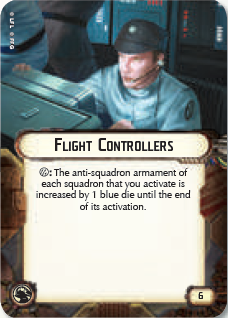
A carrier staple since day one — but 6 points is a lot, unless you're commanding 4+ squadrons.

In an ideal world, I’d make it cheaper but cap it at boosting a maximum of three squadrons per activation. That would keep it potent but reduce the “death ball” effect. Another tweak would be to ban Rogue squadrons from benefiting — no more roguing in during the Squadron Phase, then getting commanded with a boosted alpha at the top of the next turn.

Do we want to give Rogues even more relative power when commanded? Probably not. Still, as-is, it’s good — maybe too good in the right fleet — but not fundamentally broken.


Gunnery Team

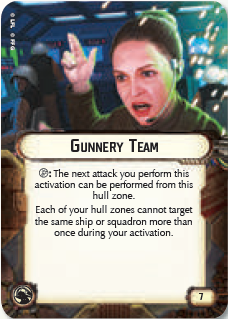
This one’s fine. You don’t see it everywhere anymore, but it still earns its keep. Cost is right, effect is clear, and it does its job. Honestly, I think you’d see it more often if other Weapons Teams weren’t cheaper and better in certain roles.


Local Fire Control

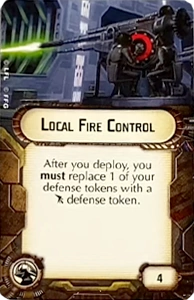
This card exists to give Rebels and Imperials access to Salvo — a mechanic introduced with the Clone Wars sets. For that, it’s priced very reasonably at 4 points, even with the Weapons Team slot cost and the requirement to swap out (presumably) your least useful defense token.

You could make a strong case that this is actually a 5+ point upgrade — but raising the price would undermine its core purpose: to give Imps and Rebs access to a whole new defensive mechanic. At 4 points, though, it creates a pricing conundrum for the entire category. If LFC is 4, why aren’t Sensor Team or Veteran Gunners also 4? On the flip side, if LFC went up to 5, those other cards would feel fine where they are.

It’s also worth noting that LFC enables some slightly questionable double-Salvo builds (Luminara comes to mind). In general, I think ships that already have Salvo probably shouldn’t be able to take it. Conceptually flawed, slightly troublesome — but also one of the most impactful cards in the slot.


Ordnance Experts

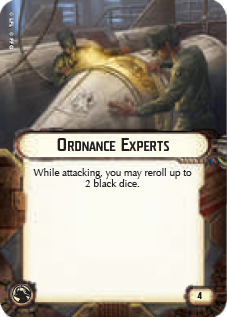
Gets the job done for 4 points. Some might argue it’s too good given how often it appears, but I disagree — it’s the only reliable way to make black dice scary in a world of PDIC, 1.5 evades, and other damage-mitigation tech.

Also, External Racks exist for 4 points, so if anything, the “problem” lies more with Racks than with OE. OE simply ensures your close-range ordnance ships can actually deliver.


Ruthless Strategists

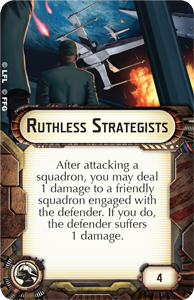
I’m not a fan of auto-damage in principle, but this card has a clear role: countering pesky aces (especially scatter aces) without relying solely on luck.

That said, we’ve all seen what happens when it’s combined with Ordnance Pods and masses of cheap, high-hull squadrons — it can be oppressive. Is it meta-breaking? Probably not, but it does limit future design space and risks warping certain matchups. For now, though, it’s just another flavour of playstyle we live with.


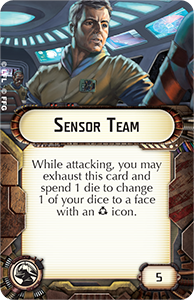
Sensor Team

A decent effect if your dice pool is large enough, but at long range — where this shines most — getting a big enough pool is tricky.

At 5 points, it’s a tough sell compared to other Weapons Teams. I’d drop it to 4 to make it competitive, but honestly, that alone won’t suddenly make it a go-to choice.


Veteran Gunners

The insurance policy against bad rolls. Great card, but it’s up against equally great competition in this slot. Is it worth 5 or 4 points? You decide — I don’t think it’s inherently better than other options, just different.


Weapons Battery Techs

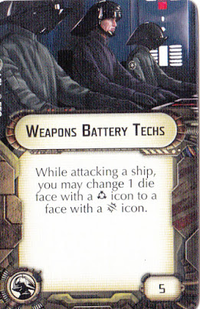
A solid effect that deserved its drop to 4 points. If other Weapons Teams get a points shave, maybe this one goes to 3 — maybe. As-is, it’s in a decent spot and sees occasional but not overwhelming use.


Unique / Faction-Locked

Clone Gunners (GAR only)

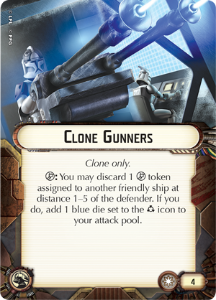
A generic in function but locked to the Republic. Absolutely amazing if you build around them and have reliable access to Concentrate Fire tokens — and at 4 points, they’re a bargain for what they can do. Their efficiency only reinforces the argument for trimming the cost on Sensor Team and maybe Veteran Gunners, which offer less consistent payoff for a similar price.


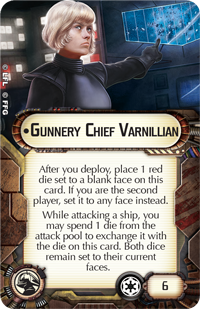
Gunnery Chief Varnillian (Imperial unique)

A solid card, but her heyday faded along with the Onager’s dominance (and its double Weapons Team slots). She really shines with Salvo builds, which puts the Imperial Venator in the spotlight — but outside of that, her opportunities are limited. Correctly costed for what she does, but her usefulness is currently capped by the meta and ship availability.


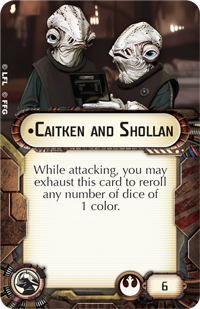
Caitken and Shollan (Rebel unique)

Incredibly potent and very flexible — at 6 points they’re a steal. They probably belong at 7, maybe even 8, given how reliably they can fix dice pools. If Ordnance Experts are the gold standard for black dice, C&S are the platinum tier for rerolls of any colour.

Verdict

The Weapons Team slot is stacked with strong cards — and for good reason. It’s one of the most powerful upgrade categories in the game, second only to Defensive Retrofits in raw impact. That means the duds (hi, Fire-Control Team) stand out sharply against the meta staples.

There’s also a pricing ripple effect here: cards like Local Fire Control, Ordnance Experts, and Caitken & Shollan deliver exceptional value at their current costs, which in turn makes middle-tier cards like Sensor Team and Veteran Gunners look overpriced even if they’re “fair” in isolation.


Faction Gaps & Slot Rarity:

CIS and GAR could definitely use some more unique cards in this category. In a way, they already kind of have one with Asajj Ventress — but she’s an Officer, likely because fitting her into a faction with so few Weapons Team slots would have been a squeeze. The new ARC Quarren Gunship and the Command Munificent both have Weapons + Offensive slots, so maybe there’s more design room coming in the future.

On the GAR side, there’s an entire roster of Jedi who could make excellent boarding teams or other thematic Weapons Team upgrades.

It’s also worth noting the overlap with other slots — Ventress aside, we have Officers like Governor Pryce (dice fixing) and Krennic (rerolls) who are effectively Weapons Teams in disguise. That tells you just how rare and valuable this slot really is.


Next Up: 

Offensive Retrofits — the grab bag of squadron toys, brawler tech, and a few of Armada’s more “what were they thinking?” designs.

Wednesday, August 13, 2025

The Upgrade Files: Case 01 - Boarding Teams

Following on from my objectives review series, it’s time to point the scanner at another part of Armada’s ecosystem: upgrade cards.

Like objectives, upgrades are one of the game’s great levers for fleet identity and playstyle. They shape what a ship can do, how it fights, and even whether it survives the trip. And, also like objectives, they’re not all created equal. Some are timeless workhorses, others are clever tech choices, and a few… well, a few have been sitting in the binder for years waiting for a home that never came.

This series will go slot by slot — not by faction, set, or release wave. Each post will take one category of upgrades and look at:

  • Where each card stands now — common, niche, or forgotten.

  • Why it’s in that spot — meta shifts, points changes, design limitations, or just plain competition.

  • What could be done — the light touch of a points tweak where possible, a wording update where necessary, and in extreme cases, a full rework or “retirement” into the trash compactor.

The goal isn’t to make every card “the best ever.” ARC themselves have said they’re not aiming for that either. The goal is to make as many cards as possible interesting enough to consider. If you see one in a fleet list and think “huh, that could work,” then we’ve done our job.

Points changes are the preferred tool — low effort, high impact. If that doesn’t get the card where it needs to be, we get creative. And if even creativity can’t save it… well, that’s why the trash compactor is there.

We’ll start small with a short category — one that’s unusual, influential, and historically a little spicy: Boarding Teams.


Boarding Teams

(Not an official term, but everyone calls them that)

Boarding Teams are a small but distinctive group of upgrades. They’re all Weapons Team + Offensive Retrofit dual-slot cards, and while the second slot isn’t as universally valuable, the Weapons Team slot is one of the most hotly contested in the game. That means every Boarding Team comes with a significant opportunity cost — you’re giving up Gunnery Teams, Ordnance Experts, or other heavy-hitters to bring them.
They’re also limited in availability: two generic cards, three unique Rebel cards, one unique Imperial card, and nothing at all for CIS or GAR.


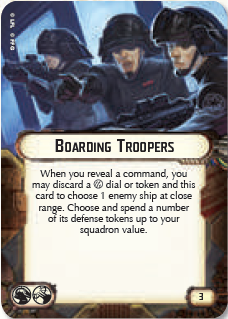
Boarding Troopers

This is the baseline against which all the others are judged. In many ways, it’s the only Boarding Team — outside of Vader for Imperial fleets — that sees consistent play.

Early on, BTs were fairly rare (outside BTA), but as the meta shifted toward tanky brawlers, their value soared. Yes, they require both close range and a squadron command (dial or token), but when they hit, they hit hard. Flipping brace (or every token the defender has) before a big shot isn’t just a solid offensive play — it can also serve as a defensive deterrent, creating a no-fly zone around the ship.

At 3 points, they’re an outright steal even with the dual-slot tax. In the current tanky big-ship meta, 4 points is a fair price — maybe even 5 in a vacuum — but 4 keeps them accessible while still acknowledging their impact.


Boarding Engineers

The runt of the litter. At 2 points, they’re cheap, but even on a Dodonna Hammerhead (where they should make sense), they almost never see play. They share BT’s limitations, but add an even bigger one: the target has to already have facedown damage cards. By the time you can use this, you’re probably already winning — and “win more” tools rarely make the cut.

Yes, you can ram to get the facedown damage, then trigger them, but that’s still a lot of work for minimal payoff. You could drop them to 1 point, and they’d still probably collect dust.

If they had a secondary effect, they’d be more interesting. Or rework entirely, to maybe hand out a single face-up damage card from a draw equal to your engineering value instead of the current mass-flip. That’d be a potent change, though, and a very different card. As it stands, their fate is: go to 1 point, add a meaningful secondary effect, completely rework them… or send them to the trash compactor.


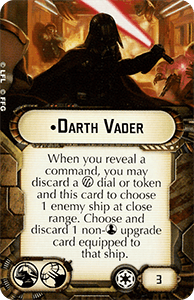
Darth Vader (Boarding)

Imperial unique. A very useful and flexible card that still sees a moderate amount of play. The effect — ditching an upgrade of your choice — is undeniably strong.

The catch is platform choice. In theory, any Imperial brawler could use him, but in practice, the Raider is the best home — and Raiders aren’t exactly thriving in the current long-range, pass-token era. Larger ships tend to want those slots for other upgrades.

At 3 points, Vader is a steal. You could argue for 4 or even 5 on effect alone, but his uniqueness and the “Vader tax” (you can’t use any other Vader card) keep him balanced. He’s good where he is.


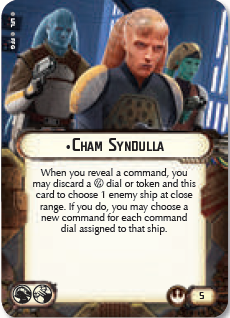
Cham Syndulla

Rebel unique. Cham’s been through the points wringer — originally 5, now down to 3 like Vader. He’s not objectively Vader-good, but unlike Vader, you’re not giving up other Cham cards to take this one. That’s a big difference.

His effect — swapping the target’s command stack — can be devastating… in the right matchup. Against an SSD, a triple-command ship, or a pure carrier without dial control, he can wreck a game plan. But outside those scenarios, he’s mostly a mild annoyance.

Too niche for my tastes, but not overpriced. He exists, he works, and in certain pairings, he’s brilliant. Just don’t expect him to shine every game.


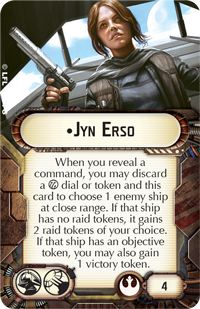
Jyn Erso

Rebel unique. Four points of (almost) useless.

She can assign two raid tokens — in a faction that generally has little use for raid — and only if the target doesn’t already have raid. That’s an oddly specific condition. The one big exception is if you’re running the new ARC General Draven commander — then she might have utility as part of a focused raid build.

Her secondary effect — stealing a victory token if the target has one — sounds neat, but in reality, there aren’t that many objectives where it will swing points meaningfully.

At the very least, the “no existing raid” limitation should go, and the cost could drop to 3. Honestly, though? She needs a full rework into something cool. Keep it raid-based if you like, but make it suck less.


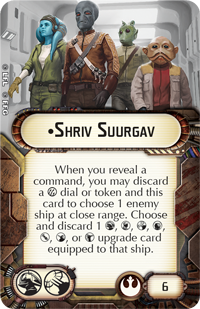
Shriv Suurgav

Rebel unique. Slightly worse Vader — he can’t discard some upgrade types — and costs 1 point more at 4 points. But he’s not a Vader, so there’s no opportunity cost there.

Shriv is fine. He does his job, and if generic Boarding Troopers go up to 4 points, he’ll be in a comfortable spot.


Verdict: A surprisingly polarized group. Boarding Troopers and Vader are great, Shriv is fine, Cham is situational, and Jyn and Engineers are either niche to the point of irrelevance or just plain bad. The dual-slot tax means they need to really do something when they trigger, and right now, only a few of them consistently deliver.


Next Up: We’ve looked at the double-slot oddballs; now it’s time for the mainline Weapons Teams. From meta staples like Gunnery Teams to the cards you only see when they fall out of a cereal box, we’ll see which ones are still firing on all cylinders — and which need a visit to the trash compactor.

Tuesday, August 12, 2025

Objectives and ARC – Part 4: Summary

Over the last three posts, we’ve gone through all 36 current objectives in Star Wars: Armada, looking at what works, what doesn’t, and where there’s room for improvement.

You can catch up here:

This series was never meant to be a “roadmap” for ARC. Think of it more as an idea bank—something to get the creative gears turning. Not every tweak or suggestion needs to be implemented. Sometimes I’ve gone for theme, sometimes for balance, sometimes just for fun.

Some changes I’ve proposed—like a general flotilla ban for objective ships, or capping maximum points from objectives—would require especially careful review. For example, reducing Superior Positions to 10 points per token might make sense, but if you also cap the total scoring potential, then maybe the current 15 per token is fine.

And when it comes to caps, finding the “right” number is tricky. Contested Outpost, for example, can yield 120 points with perfect play, but good counterplay should keep it below that—so maybe that’s fine. More than 120? Probably too much. Less? Possibly, but we’d need to test.

One other major factor to keep in mind: Pass Tokens (introduced in 1.5) have given Second Player more control over activation order, making objectives even more important—and arguably more powerful—than they were before.


What Makes a “Good” Objective?

A good objective is not just the one that hands Second Player the biggest possible advantage. Above all, it should encourage engagement—plastic spaceships should go pew pew, not orbit the map, avoiding contact for six rounds.

The best designs give Second Player a slight scoring or tactical boost if First Player refuses to engage—enough to offset the inherent advantage of going first, but not so much that Second Player is rewarded for also turtling up. Counterplay should always exist, and the “fallout risk” for Second Player shouldn’t be so high that the objective is unplayable.


Objectives in the Bigger Picture

One thing we must avoid—both when tweaking existing objectives and designing new ones—is encouraging fortressing or non-engagement. Armada is already skewed toward defense-heavy, grindy play, and that’s not healthy long-term.

The defensive tilt comes partly from the “throw everything at the wall” changes of 1.5, and partly from changes not made alongside them. Pass Tokens made activation control easier, but small ships weren’t re-costed to reflect their reduced value. Red dice are more valuable than ever, while black dice and black crit effects are weaker. Intel changes hit non-Rogue squadrons hard, and Point-Defense Ion Cannons piled on further.

The net result? Tank fleets and rogue-heavy lists are thriving, and many players are picking objectives that give a defensive edge—whether through raw points or tactical denial. That’s not what makes Armada great. Things are supposed to go boom, not limp along until time is called.

Objectives are a lever we can pull to change this. Well-designed ones encourage engagement, punish stalling, and keep both players active in the fight.


My Favorites – The Top 3 Per Color

These aren’t “the best” in pure competitive terms—they’re the ones that, to me, best meet the “good objective” criteria: encouraging engagement, offering counterplay, and giving just enough of a boost to make Second Player’s role interesting without making it unassailable.

Red

  1. Most Wanted (with flotilla nerf) – A classic that forces conflict and meaningful target priority.

  2. Opening Salvo – Rewarding aggression and engagement from both sides.

  3. Blockade Run – Flawed but fun, with a unique setup that can produce dynamic games.

Yellow

  1. Contested Outpost – Points for holding ground, with real counterplay for First Player.

  2. Hyperspace Assault – A unique tactical twist that changes deployment and approach patterns.

  3. Fighter Ambush (if fixed) – Offers both scoring and real tactical impact.

Blue

  1. Infested Fields – Movement, obstacle play, and squadrons in one neat package.

  2. Solar Corona – Simple, interactive, and subtly shifts the tactical puzzle.

  3. Doomed Station – A Contested Outpost variant where everything moves.


Fix These First

If ARC wanted to make a short “fix now” list, these would be my priorities:

  • Fleet Ambush – Perennial worst-in-class; currently a trap for Second Player.

  • Targeting Beacons – As written, completely fails to do its job.

  • Navigational Hazards – Currently irrelevant; needs teeth.

  • Sensor Net – Token shuffling at its most degenerate.
  • Hyperspace Migration – Works in 3×3 RitR games, a mess in full-size.

Honorable mentions:
  • Fighter Ambush/Fleet Ambush – Make them feel like ambushes with their own unique flair.

Looking Ahead – New Objective Ideas

Beyond fixing the current lineup, I’d love to see ARC explore:

  • Alternate deployment zones – More objectives like Blockade Run that change the geometry of the battlefield.

  • Reskinned obstacles – Using existing obstacle pieces with new rules for specific objectives. My “Energy Fields” variant for Ion Storm is an example: same dust field cardboard, but a different, thematic in-game effect.

Fresh objectives with these twists could add real variety without needing new physical components—important for accessibility and easy adoption.


That's all for this 4-part series, but in later posts I'll return to other topics I think ARC should be looking at going forward: the state of squadrons, defense/tanking, problematic upgrades, and more. 

In the meantime, stay tuned for more about the Battle for Endor, planning a new campaign, and more!

Monday, August 11, 2025

Battle for Endor: Listbuilding pt. 3 - Rebel Mothma Squids


Mon Mothma... that's a name I haven't heard since Ard put the fear of the MC30 into me. IMO, the 2.0 version of MM is pretty irrelevant. Craken offers a more consistent damage reduction across the fleet, while Agate is better when you run a decked-out MC30.

The Mommy Mothma 3.0 (the ARC01 one) does have a redeeming feature, however: she can ECM your evade tokens, which makes her interesting on both double and single evade ships. You're still limited by your evade tokens; they are not limitless, but as long as they last, she'll get to actually use her ability to enhance your evades.

While she isn't overpowered in any sense of the word, she looks like she can be a bit annoying. A properly built MSU/rogue ball featuring Mommy M can be hard to get at, let alone score many points off. She's somewhat of a soft counter to nuScreed - though not at Close - and would make the overpriced Onagers even sadder than they already are.

Note: MC30s are squids, not shrimps. Anyone can see that. And the QUARREN GUNSHIP settles this once and for all - they are literally SQUIDS THEMSELVES!!!

How I Approach Listbuilding

Before diving into more fleets for the Battle for Endor event, here’s a quick look at how I personally approach listbuilding. I’m not claiming to be the most creative or the guy who breaks the meta every month—but after ten years of flying little plastic spaceships, I have a pretty solid feel for what works and what usually doesn’t.

  1. Concept is key.
    Decide what you want your fleet to do—and how it’s going to do it. Everything else flows from that core idea.

  2. Lean into synergies.
    Commanders, objectives, upgrades—if they make your list’s strong points stronger, you’re probably on the right track.

  3. Don’t try to do everything.
    This is a 400-point game, not a “cover every base” simulator. Pick your strengths and focus there.

  4. Know your weaknesses.
    Decide how you’re going to handle them: tweak the list, develop specific tactics, or just accept some bad matchups as part of the plan. But don’t overcomplicate this step—you can’t future-proof against everything.

  5. Don’t sweat the last few points.
    Whether Bright Hope takes Jamming Field, Slicers, or Comms Net, all of them are the “correct” choice depending on how a game actually plays out. Make a call and move on (I will, of course, still fret).

  6. Bidding is optional.
    I rarely bid unless I have a very specific reason. If I can get to 400 without sacrificing the concept, I do. It's just a personal preference.

  7. Playtest.
    Armada has good and bad lists, but many “off-meta” builds can work with enough practice. Test against a wide variety of fleets—especially the ones you think will give you trouble.

  8. Embrace the last-minute panic.
    Right before the event, second-guess everything, throw the list out, and take something that “feels right” despite minimal playtesting. This is the way.

Applying the concepts

For this list, I'm doing MM + double evades (and a scatter/evade Bright Hope, almost as annoying), and some rogues to screen me and provide some bombing support against squadless or squad light. The list does have some weaknesses, and I can already see both some 134-squad and all-ship lists that could give me trouble, or fleets with bigger rogue balls, but I'm confident that even the hard matchup will be hard-pressed to milk me for very many points.

I'd like a fifth ship, but then I must either sacrifice squads (nope) or drop a MC30 to another TRC90 (fine, but that's not a double squid list anymore, so no). EST + AP on Admo is semi-redundant, but they serve complementary functions, so I like this. Admo could easily be a torpedo frigate but this makes it a lot more obvious which ship will do what.

Things I could fret over: Whether to bring Slicers or not on BH. If the flagship should have Blast Doors. Is Toryn Farr worth it here, or is Hondo more useful? Why is there no Comms Net in this list? And so forth. But those are the minor changes that won't really make or break my list, so I should start playtesting instead.

Same with the objective selection. Infested or Volatile, for example. Volatile ties me down a bit, but fits well with Ion Storm. But again, better get playtesting and tweak the little stuff later.

Final words: While I think this is a promising MM list... It's not really the kind of list I enjoy playing the most. I prefer lists with a centerpiece ship + supporting ships & squadrons. So maybe if I could jam Amity into this 😅


### 400 points ###

Name: Yo Mothma

Faction: Rebels

Commander: Mon Mothma

Version: ARC01


Assault: Ion Storm

Defense: Asteroid Tactics

Navigation: Infested Fields


MC30c Scout Frigate (69)

• Mon Mothma (27)

• Expert Shield Tech (5)

• Ordnance Experts (4)

• Reinforced Blast Doors (5) (optional)

• Assault Proton Torpedoes (4)

• Turbolaser Reroute Circuits (7)

• Foresight (10)

= 131 Points


MC30c Scout Frigate (69)

• Expert Shield Tech (5)

• Ordnance Experts (4)

• Advanced Projectors (6)

• Assault Proton Torpedoes (4)

• Turbolaser Reroute Circuits (7)

• Admonition (10)

= 105 Points


CR90 Corvette A (44)

• Turbolaser Reroute Circuits (7)

• Jaina's Light (5)

= 56 Points


GR-75 Medium Transports (18)

• Toryn Farr (7) (or Hondo)

• Jamming Field (2) (or Comms Net or Slicer Tools)

• Bright Hope (2)

= 29 Points


Squadrons:

• Shara Bey (17)

• Tycho Celchu (16)

• Lando Calrissian (24)

• Ketsu Onyo (22) (or Corran Horn for more AS)

= 79 Points


Total Points: 400