Wednesday, August 13, 2025

The Upgrade Files: Case 01 - Boarding Teams

Following on from my objectives review series, it’s time to point the scanner at another part of Armada’s ecosystem: upgrade cards.

Like objectives, upgrades are one of the game’s great levers for fleet identity and playstyle. They shape what a ship can do, how it fights, and even whether it survives the trip. And, also like objectives, they’re not all created equal. Some are timeless workhorses, others are clever tech choices, and a few… well, a few have been sitting in the binder for years waiting for a home that never came.

This series will go slot by slot — not by faction, set, or release wave. Each post will take one category of upgrades and look at:

  • Where each card stands now — common, niche, or forgotten.

  • Why it’s in that spot — meta shifts, points changes, design limitations, or just plain competition.

  • What could be done — the light touch of a points tweak where possible, a wording update where necessary, and in extreme cases, a full rework or “retirement” into the trash compactor.

The goal isn’t to make every card “the best ever.” ARC themselves have said they’re not aiming for that either. The goal is to make as many cards as possible interesting enough to consider. If you see one in a fleet list and think “huh, that could work,” then we’ve done our job.

Points changes are the preferred tool — low effort, high impact. If that doesn’t get the card where it needs to be, we get creative. And if even creativity can’t save it… well, that’s why the trash compactor is there.

We’ll start small with a short category — one that’s unusual, influential, and historically a little spicy: Boarding Teams.


Boarding Teams

(Not an official term, but everyone calls them that)

Boarding Teams are a small but distinctive group of upgrades. They’re all Weapons Team + Offensive Retrofit dual-slot cards, and while the second slot isn’t as universally valuable, the Weapons Team slot is one of the most hotly contested in the game. That means every Boarding Team comes with a significant opportunity cost — you’re giving up Gunnery Teams, Ordnance Experts, or other heavy-hitters to bring them.

They’re also limited in availability: two generic cards, three unique Rebel cards, one unique Imperial card, and nothing at all for CIS or GAR.


Boarding Troopers
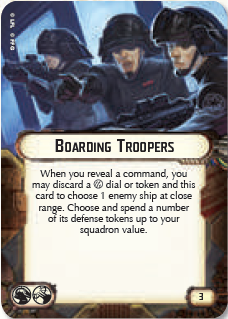
This is the baseline against which all the others are judged. In many ways, it’s the only Boarding Team — outside of Vader for Imperial fleets — that sees consistent play.

Early on, BTs were fairly rare (outside BTA), but as the meta shifted toward tanky brawlers, their value soared. Yes, they require both close range and a squadron command (dial or token), but when they hit, they hit hard. Flipping brace (or every token the defender has) before a big shot isn’t just a solid offensive play — it can also serve as a defensive deterrent, creating a no-fly zone around the ship.

At 3 points, they’re an outright steal even with the dual-slot tax. In the current tanky big-ship meta, 4 points is a fair price — maybe even 5 in a vacuum — but 4 keeps them accessible while still acknowledging their impact.


Boarding Engineers

The runt of the litter. At 2 points, they’re cheap, but even on a Dodonna Hammerhead (where they should make sense), they almost never see play. They share BT’s limitations, but add an even bigger one: the target has to already have facedown damage cards. By the time you can use this, you’re probably already winning — and “win more” tools rarely make the cut.

Yes, you can ram to get the facedown damage, then trigger them, but that’s still a lot of work for minimal payoff. You could drop them to 1 point, and they’d still probably collect dust.

If they had a secondary effect, they’d be more interesting. Or rework entirely, to maybe hand out a single face-up damage card from a draw equal to your engineering value instead of the current mass-flip. That’d be a potent change, though, and a very different card. As it stands, their fate is: go to 1 point, add a meaningful secondary effect, completely rework them… or send them to the trash compactor.


Darth Vader (Boarding)
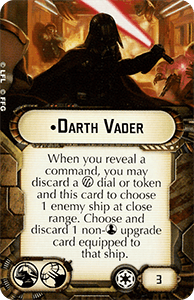
Imperial unique. A very useful and flexible card that still sees a moderate amount of play. The effect — ditching an upgrade of your choice — is undeniably strong.

The catch is platform choice. In theory, any Imperial brawler could use him, but in practice, the Raider is the best home — and Raiders aren’t exactly thriving in the current long-range, pass-token era. Larger ships tend to want those slots for other upgrades.

At 3 points, Vader is a steal. You could argue for 4 or even 5 on effect alone, but his uniqueness and the “Vader tax” (you can’t use any other Vader card) keep him balanced. He’s good where he is.


Cham Syndulla
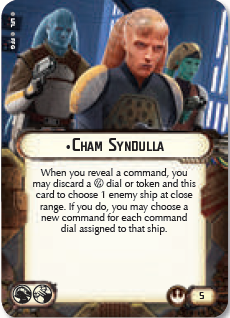
Rebel unique. Cham’s been through the points wringer — originally 5, now down to 3 like Vader. He’s not objectively Vader-good, but unlike Vader, you’re not giving up other Cham cards to take this one. That’s a big difference.

His effect — swapping the target’s command stack — can be devastating… in the right matchup. Against an SSD, a triple-command ship, or a pure carrier without dial control, he can wreck a game plan. But outside those scenarios, he’s mostly a mild annoyance.

Too niche for my tastes, but not overpriced. He exists, he works, and in certain pairings, he’s brilliant. Just don’t expect him to shine every game.


Jyn Erso
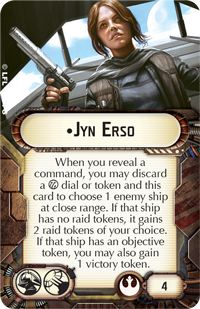
Rebel unique. Four points of (almost) useless.

She can assign two raid tokens — in a faction that generally has little use for raid — and only if the target doesn’t already have raid. That’s an oddly specific condition. The one big exception is if you’re running the new ARC General Draven commander — then she might have utility as part of a focused raid build.

Her secondary effect — stealing a victory token if the target has one — sounds neat, but in reality, there aren’t that many objectives where it will swing points meaningfully.

At the very least, the “no existing raid” limitation should go, and the cost could drop to 3. Honestly, though? She needs a full rework into something cool. Keep it raid-based if you like, but make it suck less.


Shriv Suurgav
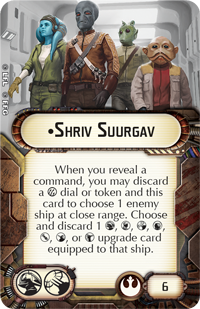
Rebel unique. Slightly worse Vader — he can’t discard some upgrade types — and costs 1 point more at 4 points. But he’s not a Vader, so there’s no opportunity cost there.

Shriv is fine. He does his job, and if generic Boarding Troopers go up to 4 points, he’ll be in a comfortable spot.


Verdict: A surprisingly polarized group. Boarding Troopers and Vader are great, Shriv is fine, Cham is situational, and Jyn and Engineers are either niche to the point of irrelevance or just plain bad. The dual-slot tax means they need to really do something when they trigger, and right now, only a few of them consistently deliver.


Next Up: We’ve looked at the double-slot oddballs; now it’s time for the mainline Weapons Teams. From meta staples like Gunnery Teams to the cards you only see when they fall out of a cereal box, we’ll see which ones are still firing on all cylinders — and which need a visit to the trash compactor.

Tuesday, August 12, 2025

Objectives and ARC – Part 4: Summary

Over the last three posts, we’ve gone through all 36 current objectives in Star Wars: Armada, looking at what works, what doesn’t, and where there’s room for improvement.

You can catch up here:

This series was never meant to be a “roadmap” for ARC. Think of it more as an idea bank—something to get the creative gears turning. Not every tweak or suggestion needs to be implemented. Sometimes I’ve gone for theme, sometimes for balance, sometimes just for fun.

Some changes I’ve proposed—like a general flotilla ban for objective ships, or capping maximum points from objectives—would require especially careful review. For example, reducing Superior Positions to 10 points per token might make sense, but if you also cap the total scoring potential, then maybe the current 15 per token is fine.

And when it comes to caps, finding the “right” number is tricky. Contested Outpost, for example, can yield 120 points with perfect play, but good counterplay should keep it below that—so maybe that’s fine. More than 120? Probably too much. Less? Possibly, but we’d need to test.

One other major factor to keep in mind: Pass Tokens (introduced in 1.5) have given Second Player more control over activation order, making objectives even more important—and arguably more powerful—than they were before.


What Makes a “Good” Objective?

A good objective is not just the one that hands Second Player the biggest possible advantage. Above all, it should encourage engagement—plastic spaceships should go pew pew, not orbit the map, avoiding contact for six rounds.

The best designs give Second Player a slight scoring or tactical boost if First Player refuses to engage—enough to offset the inherent advantage of going first, but not so much that Second Player is rewarded for also turtling up. Counterplay should always exist, and the “fallout risk” for Second Player shouldn’t be so high that the objective is unplayable.


Objectives in the Bigger Picture

One thing we must avoid—both when tweaking existing objectives and designing new ones—is encouraging fortressing or non-engagement. Armada is already skewed toward defense-heavy, grindy play, and that’s not healthy long-term.

The defensive tilt comes partly from the “throw everything at the wall” changes of 1.5, and partly from changes not made alongside them. Pass Tokens made activation control easier, but small ships weren’t re-costed to reflect their reduced value. Red dice are more valuable than ever, while black dice and black crit effects are weaker. Intel changes hit non-Rogue squadrons hard, and Point-Defense Ion Cannons piled on further.

The net result? Tank fleets and rogue-heavy lists are thriving, and many players are picking objectives that give a defensive edge—whether through raw points or tactical denial. That’s not what makes Armada great. Things are supposed to go boom, not limp along until time is called.

Objectives are a lever we can pull to change this. Well-designed ones encourage engagement, punish stalling, and keep both players active in the fight.


My Favorites – The Top 3 Per Color

These aren’t “the best” in pure competitive terms—they’re the ones that, to me, best meet the “good objective” criteria: encouraging engagement, offering counterplay, and giving just enough of a boost to make Second Player’s role interesting without making it unassailable.

Red

  1. Most Wanted (with flotilla nerf) – A classic that forces conflict and meaningful target priority.

  2. Opening Salvo – Rewarding aggression and engagement from both sides.

  3. Blockade Run – Flawed but fun, with a unique setup that can produce dynamic games.

Yellow

  1. Contested Outpost – Points for holding ground, with real counterplay for First Player.

  2. Hyperspace Assault – A unique tactical twist that changes deployment and approach patterns.

  3. Fighter Ambush (if fixed) – Offers both scoring and real tactical impact.

Blue

  1. Infested Fields – Movement, obstacle play, and squadrons in one neat package.

  2. Solar Corona – Simple, interactive, and subtly shifts the tactical puzzle.

  3. Doomed Station – A Contested Outpost variant where everything moves.


Fix These First

If ARC wanted to make a short “fix now” list, these would be my priorities:

  • Fleet Ambush – Perennial worst-in-class; currently a trap for Second Player.

  • Targeting Beacons – As written, completely fails to do its job.

  • Navigational Hazards – Currently irrelevant; needs teeth.

  • Sensor Net – Token shuffling at its most degenerate.
  • Hyperspace Migration – Works in 3×3 RitR games, a mess in full-size.

Honorable mentions:
  • Fighter Ambush/Fleet Ambush – Make them feel like ambushes with their own unique flair.

Looking Ahead – New Objective Ideas

Beyond fixing the current lineup, I’d love to see ARC explore:

  • Alternate deployment zones – More objectives like Blockade Run that change the geometry of the battlefield.

  • Reskinned obstacles – Using existing obstacle pieces with new rules for specific objectives. My “Energy Fields” variant for Ion Storm is an example: same dust field cardboard, but a different, thematic in-game effect.

Fresh objectives with these twists could add real variety without needing new physical components—important for accessibility and easy adoption.


That's all for this 4-part series, but in later posts I'll return to other topics I think ARC should be looking at going forward: the state of squadrons, defense/tanking, problematic upgrades, and more. 

In the meantime, stay tuned for more about the Battle for Endor, planning a new campaign, and more!

Monday, August 11, 2025

Battle for Endor: Listbuilding pt. 3 - Rebel Mothma Squids


Mon Mothma... that's a name I haven't heard since Ard put the fear of the MC30 into me. IMO, the 2.0 version of MM is pretty irrelevant. Craken offers a more consistent damage reduction across the fleet, while Agate is better when you run a decked-out MC30.

The Mommy Mothma 3.0 (the ARC01 one) does have a redeeming feature, however: she can ECM your evade tokens, which makes her interesting on both double and single evade ships. You're still limited by your evade tokens; they are not limitless, but as long as they last, she'll get to actually use her ability to enhance your evades.

While she isn't overpowered in any sense of the word, she looks like she can be a bit annoying. A properly built MSU/rogue ball featuring Mommy M can be hard to get at, let alone score many points off. She's somewhat of a soft counter to nuScreed - though not at Close - and would make the overpriced Onagers even sadder than they already are.

Note: MC30s are squids, not shrimps. Anyone can see that. And the QUARREN GUNSHIP settles this once and for all - they are literally SQUIDS THEMSELVES!!!

How I Approach Listbuilding

Before diving into more fleets for the Battle for Endor event, here’s a quick look at how I personally approach listbuilding. I’m not claiming to be the most creative or the guy who breaks the meta every month—but after ten years of flying little plastic spaceships, I have a pretty solid feel for what works and what usually doesn’t.

  1. Concept is key.
    Decide what you want your fleet to do—and how it’s going to do it. Everything else flows from that core idea.

  2. Lean into synergies.
    Commanders, objectives, upgrades—if they make your list’s strong points stronger, you’re probably on the right track.

  3. Don’t try to do everything.
    This is a 400-point game, not a “cover every base” simulator. Pick your strengths and focus there.

  4. Know your weaknesses.
    Decide how you’re going to handle them: tweak the list, develop specific tactics, or just accept some bad matchups as part of the plan. But don’t overcomplicate this step—you can’t future-proof against everything.

  5. Don’t sweat the last few points.
    Whether Bright Hope takes Jamming Field, Slicers, or Comms Net, all of them are the “correct” choice depending on how a game actually plays out. Make a call and move on (I will, of course, still fret).

  6. Bidding is optional.
    I rarely bid unless I have a very specific reason. If I can get to 400 without sacrificing the concept, I do. It's just a personal preference.

  7. Playtest.
    Armada has good and bad lists, but many “off-meta” builds can work with enough practice. Test against a wide variety of fleets—especially the ones you think will give you trouble.

  8. Embrace the last-minute panic.
    Right before the event, second-guess everything, throw the list out, and take something that “feels right” despite minimal playtesting. This is the way.

Applying the concepts

For this list, I'm doing MM + double evades (and a scatter/evade Bright Hope, almost as annoying), and some rogues to screen me and provide some bombing support against squadless or squad light. The list does have some weaknesses, and I can already see both some 134-squad and all-ship lists that could give me trouble, or fleets with bigger rogue balls, but I'm confident that even the hard matchup will be hard-pressed to milk me for very many points.

I'd like a fifth ship, but then I must either sacrifice squads (nope) or drop a MC30 to another TRC90 (fine, but that's not a double squid list anymore, so no). EST + AP on Admo is semi-redundant, but they serve complementary functions, so I like this. Admo could easily be a torpedo frigate but this makes it a lot more obvious which ship will do what.

Things I could fret over: Whether to bring Slicers or not on BH. If the flagship should have Blast Doors. Is Toryn Farr worth it here, or is Hondo more useful? Why is there no Comms Net in this list? And so forth. But those are the minor changes that won't really make or break my list, so I should start playtesting instead.

Same with the objective selection. Infested or Volatile, for example. Volatile ties me down a bit, but fits well with Ion Storm. But again, better get playtesting and tweak the little stuff later.

Final words: While I think this is a promising MM list... It's not really the kind of list I enjoy playing the most. I prefer lists with a centerpiece ship + supporting ships & squadrons. So maybe if I could jam Amity into this 😅


### 400 points ###

Name: Yo Mothma

Faction: Rebels

Commander: Mon Mothma

Version: ARC01


Assault: Ion Storm

Defense: Asteroid Tactics

Navigation: Infested Fields


MC30c Scout Frigate (69)

• Mon Mothma (27)

• Expert Shield Tech (5)

• Ordnance Experts (4)

• Reinforced Blast Doors (5) (optional)

• Assault Proton Torpedoes (4)

• Turbolaser Reroute Circuits (7)

• Foresight (10)

= 131 Points


MC30c Scout Frigate (69)

• Expert Shield Tech (5)

• Ordnance Experts (4)

• Advanced Projectors (6)

• Assault Proton Torpedoes (4)

• Turbolaser Reroute Circuits (7)

• Admonition (10)

= 105 Points


CR90 Corvette A (44)

• Turbolaser Reroute Circuits (7)

• Jaina's Light (5)

= 56 Points


GR-75 Medium Transports (18)

• Toryn Farr (7) (or Hondo)

• Jamming Field (2) (or Comms Net or Slicer Tools)

• Bright Hope (2)

= 29 Points


Squadrons:

• Shara Bey (17)

• Tycho Celchu (16)

• Lando Calrissian (24)

• Ketsu Onyo (22) (or Corran Horn for more AS)

= 79 Points


Total Points: 400

The Objective Files – Part 3: Rebellion in the Rim


Now we arrive at the final set of published objectives: the 12 new cards introduced in Rebellion in the Rim.

And you know what? They’re actually pretty good.

It’s almost as if the designers at FFG finally sat down and asked: 

"What kinds of objectives are missing from the game? What holes are there in the current meta? And what would be both fun and competitive to play?"

The result is a surprisingly solid set of objectives. Some of these (Infested Fields, Volatile Deposits) have become staples in tournament lists. Others offer fun, flavorful mechanics with tactical depth—something the game needed more of. The only one I actively despise is Hyperspace Migration, and the only total dud is Fleet in Being, and that one isn't that bad, just not good 😆

This set also introduced three new obstacle types, all of which are tied to specific objectives:

  • Gravity Rifts, which pull and push ships in dangerous ways.

  • Space Slugs, which eat squadrons. (It’s in the name.)

  • Space Whales, which move around and really don’t like being landed on.

Finally, keep in mind that RitR may have been designed primarily with a half-sized play area in mind. That may affect how some objectives scale to full tournament play, and we’ll flag it where relevant.

⚔️ Assault Objectives (Red) – Rebellion in the Rim

Unlike Corellian Conflict, the red objectives in RitR don’t suffer from outright bad design. None are broken. None are total garbage. Instead, they lean toward creative and thematic—though not all of them reach competitive viability. Let’s dig in.


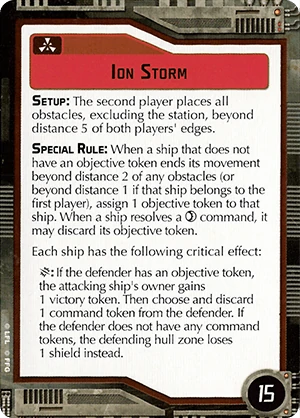
Ion Storm

Tactical: Setup control of obstacles, slight edge later.
Scoring: Modest and contested.
Play Rate: Underused but not totally absent

This objective is solid. Second Player places all obstacles, which can be a big edge for terrain-heavy lists. Removing the station also helps certain builds. There’s real value here, but the actual scoring impact is pretty mild, and the interaction is often too subtle to justify the pick.

Fixes:

  • Require spending 2 engineering points to remove an objective token, instead of removing it for free. This adds cost and weight to the decision.

  • Optional: Introduce "Energy Fields" (a renamed version of dust fields) to spice things up:

When a ship ends its activation at Distance 1 of an Energy Field, its owner must discard 1 command token and suffer 1 damage.
Squadrons suffer 1 damage instead.

This isn’t necessary—but it would make for a fun thematic twist.

Verdict: Fine as is.


Marked for Destruction

Tactical: Basically nil.
Scoring: Hard to achieve.
Play Rate: Very low but not zero

This is one of the most thematic objectives in the entire game. It’s fun, but even when played well, it's hard not to think another objective would have been better. It's not far from being good, however. If you've played it in RitR you're likely to have a rather higher opinion of it, as the smaller map makes the dust fields and space whale movement more impactful, and the scoring opportunities more frequent.

Let’s see if we can fix that without overcomplicating things or changing the flavor too much.

Fixes:

  • Second Player places the objective token after fleet deployment, letting them bait or threaten better.

  • Require the Purrgil to always move toward a token if it exists. Prevents it from floating off into irrelevance.

  • Ensure Ezra and similar effects can interact with the token—it’s thematic and encourages creative plays.

This won't do much, to be honest, but I'm out of ideas without a radical rework.

Verdict: Worth saving.


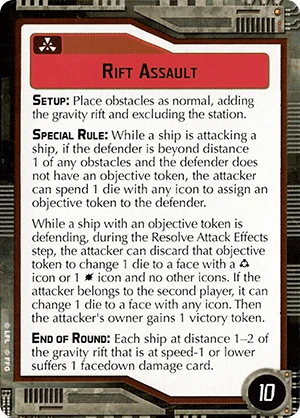
Rift Assault

Tactical: Dice fixing edge to the 2nd player.
Scoring: Usually moderate and balanced.
Play Rate: Sometimes.

There’s not much wrong here. It introduces a fun, dangerous Gravity Rift, has real counterplay, and both players can score—the Second Player’s edge is slim, which is probably a reason you don't see this too often.

Fun fact: This objective is slightly less strong in RitR since the obstacles are more packed and it's thus easier to avoid the special rule.

Verdict: Leave it as-is IF global objective scoring gets capped or rebalanced as suggested in earlier parts. Otherwise, its “fairness” becomes a liability compared to higher-swing alternatives.

Verdict: One of the better designs. Let it breathe.


Surprise Attack

Tactical: Debilitating setup and raid.
Scoring: None.
Play Rate: Sometimes.

This one’s fine mechanically. It is, of course, stronger with TF or in an Interdictor/Onager combo (but you don't see too many of those ATM), but overall it's not wrong to force deployment of the enemy flagship AND hand out tons of raid. Raid might not be that powerful, but you get a lot of it for free.

But let’s be honest: in practice, this can lead to three rounds of the first player running away/stalling, followed by each side's attempt to get ahead in score. 

Verdict: Balanced and occasionally excellent. Just… not that fun sometimes.

🚢 Navigation Objectives (Yellow) – Rebellion in the Rim

The yellow objectives in RitR are an interesting mix of tactical rewards, positional play, and scoring. There are some issues, however. Abandoned Mining Facility can lead to runaway scoring. Fleet in Being is a dud. Rift Ambush is tuned for the campaign's 3x3 play area. But with a few tweaks, I think the yellows can be brought into compliance.


Abandoned Mining Facility

Tactical: The usual slight advantage in obstacle placement and whale movement.
Scoring: Can be extreme.
Play Rate: High in token-farming builds.

This is a very strong yellow objective. The combination of reliable scoring and some battlefield control makes it quite popular. 

Optional tweaks:

  • Introduce a scoring cap (e.g., 80–100 points).

  • Optionally, require First Player to move the space whale toward the nearest ship. I often see the second whale just being sent off to one side. But not really a needed fix.

Verdict: Still one of the best yellows. Minor guardrails might keep it from being oppressive.


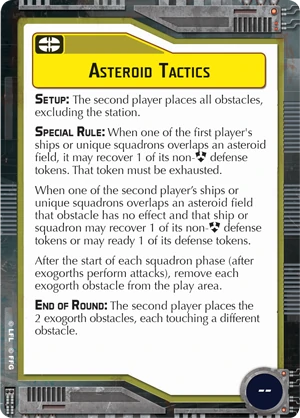
Asteroid Tactics

Tactical: High.
Scoring: None.
Play Rate: Moderate.

This is a clean design. Solid tactical buff for Second Player ships that fly smart, and a significant boost to your squadron game if you can use the board and slugs well. Some fleets benefit more than others, but that's why we have many objectives to choose between. Rewards good obstacle placement and maneuvering.

Verdict: No changes needed. One of the best-designed yellow objectives.


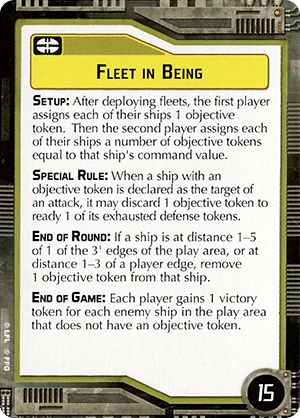
Fleet In Being

Tactical: Defensive support, in theory.
Scoring: Slight.
Play Rate: Rare.

This one should be good. It screams "bring me Obi-Wan, Thermal Shields, and a Shield Tech." But in practice, it underperforms. Either the tokens don't get spent, or the tactical benefit doesn't quite materialize.

Two suggested reworks:

  1. Scoring Layer:

    • At the end of the game, each player scores 10 points for each of their ships that retained at least one token.

    This rewards disciplined play and creates a mini-game around conservation. Still meh tho.

  2. Radical Rework:

    • When spending a redirect token, you may also spend a token targeted by an accuracy icon.

    Yes, it’s spicy. But it could be a powerful mechanic for token-centric fleets, especially if paired with Obi-Wan. But I suppose, as usual, it would actually be Lumi who benefits more. She's a cool commander, but she really does impact design space.

Verdict: Needs help to be viable.


Rift Ambush

Tactical: Total obstacle control and slight advantage around the rift.
Scoring: None.
Play Pattern: Can fizzles at 6x3 scale.

This was clearly designed for 3x3 RitR play, where maneuvering is tight and every early shift counts. On a full board, its impact is often reduced—it does offer some board control, but it is not enough to make this a mainstream objective.

Full-scale tweaks:

  • Increase Gravity Rift effect range to 1–3 (or even 1–4, though this is pretty huge) to compensate for board size.

  • Allow Second Player to reposition TWO enemy ships at the start of the game.

These changes let the objective retain its campaign flavor while having teeth on a standard map.

Verdict: Great concept. Needs full-table tuning to shine.

🛡️ Defense Objectives (Blue) – Rebellion in the Rim

RitR’s blue objectives are a big step up from the chaos of Sensor Net and Navigational Hazards. These cards explore positional pressure, obstacle interaction, and movement across the board in ways that feel dynamic and—mostly—fun. Still, a few need tweaks to bring them up to full-table standard.


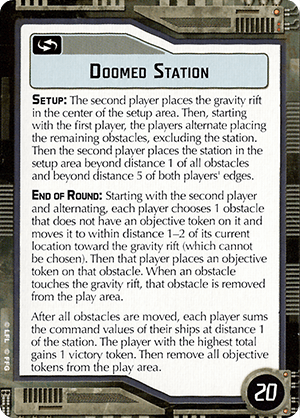
Doomed Station

Tactical: None unless you count obstacle movement.
Scoring: Strong if not contested.
Play Rate: Underrated.

This is essentially a blue-flavored Contested Outpost, but with moving parts and less obvious counterplay. It’s solid and thematic—but it rarely makes the cut because Infested Fields usually does the same thing better.

Suggested tweak:

  • After placing the Gravity Rift, the Second Player places the first obstacle.

It’s a small buff, but one that gives obstacle-heavy lists a slight edge—and encourages a closer look at this often-overlooked card.

Verdict: Playable. Just needs a nudge to rise above the pack.


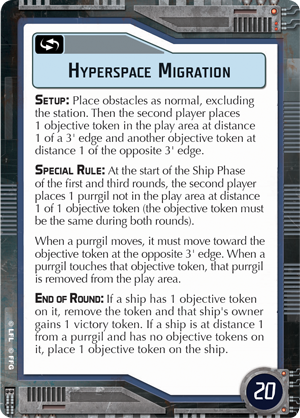
Hyperspace Migration

Tactical: Zero.
Scoring: Toxic.
Fun Factor: Stop. Please stop.

This card is infamous—Strategic token-farming at its worst. The whales just bump into ships while Second Player hoovers up tokens. Yikes.

Salvage attempt (full-scale revision):

  • Tokens must be placed in opposite corners of the setup area, not the play area. 

  • Purrgills thus must move across, not along the edge of the table.

  • Increase Purrgill speed to make the migration feel meaningful and force engagement.

This reimagining restores the "migration" feel and breaks the static loop of corner farming. Will it be perfect? No. But it might be tolerable. On the other hand, where is the second player's advantage now?

Verdict: Currently awful. Needs a thematic overhaul to become fun again, but this might not be it.


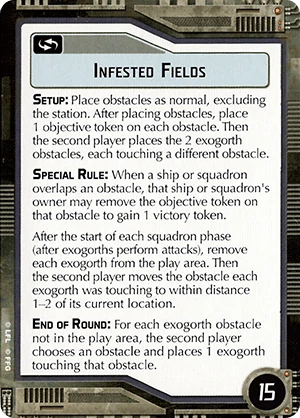
Infested Fields

Tactical: High, obstacle movement, and slugs.
Scoring: Usually max 15 points to one player.
Play Rate: Very popular.

This is one of the best blue objectives in the game. It's tactical, thematic, and not easily abusable—plus, it punishes bad squad placement and rewards smart play.

Verdict: Leave it alone. It’s great as-is.


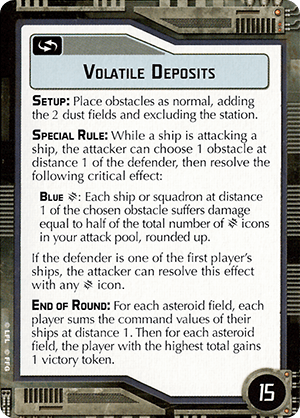
Volatile Deposits

Tactical: Definitely a thing, although not the main thing for this objective.
Scoring: Net 15 per round for the 2nd player for much of the game.
Play Rate: Decently high.

This objective creates a real “tension zone” and encourages bold plays. Scoring is impactful but not out of control—at 15 points per token, you can gain or lose a significant lead based on area control.

Optional tweaks:

  • Add a scoring cap or limit the total number of tokens.

Verdict: One of the best objectives. Consider a cap—but don’t over-nerf.


🧭 Closing Thoughts – Rebellion in the Rim

Compared to previous expansions, Rebellion in the Rim stands tall. It’s clear the designers made an effort to fill gaps in the objective pool, creating cards that were fun, flavorful, and competitive. Token-farming is still present, but much more reined in than in the Corellian Conflict era. Strategic abuse is no longer the defining feature of every yellow and blue objective.

That said, some cards (Hyperspace Migration) were clearly built with the 3x3 RitR campaign format in mind, and don’t translate well to full-scale play. Others (Fleet in Being, Marked for Destruction) are strong in theme but weak in execution—yet perhaps salvageable with light reworks.

All in all, RitR brought some of the best-designed objectives to the game—and with a few tweaks, its weakest cards could rise to the same standard.

All in all, RitR brought some of the best-designed objectives to the game—and with a few tweaks, its weakest cards could rise to the same standard.


🔜 What’s Next?

That wraps up our tour of the 36 printed objectives in Armada. In Part 4, we’ll zoom out and look at the big picture:

  • What’s missing from the current objective pool?

  • Which objectives are tournament staples—and which ones should be?

  • How could ARC approach objective rebalancing in a post-RitR world?

  • Should we design entirely new objectives, fix the ones we have, or leave them the hell alone?

We'll also compile a Top 3 per color, a "Needs a Fix" shortlist, and a few wild ideas that ARC might consider in the future.

Stay tuned.

Sunday, August 10, 2025

Warlords update


Bug fixes: 

1. Removing upgrades now correctly closes the picker and updates points.

Sorry about any inconvenience this bug may have caused.

Known bugs: 

1. Sometimes when you save a fleet and then continue editing, when you save, a new copy of the list will be created. No biggie, but kind of annoying. Working on a fix.

2. When editing an existing fleet, when removing a slot-adding upgrade such as Chimaera, Liberator, etc., removing that upgrade will not correctly reset slots. Working on a fix.

Battle for Endor: Listbuilding pt. 2 - GAR Luminara All-ship

Before we move on to some lists with squadrons, I wanted to share the GAR equivalent of my MT all-ship list. Again, the goal is to play with the new toys, which is the HEIGHT of competitive list-building!

This one leverages Lumianara for a defensive boost and IF! for a bit of dice fixing. The new Imperator will dash in and smash face. Lumi will sweep. The Arq can spam CF and get a good amount of 6 dice attack pools even at long range. With no Vet Gunners, it CAN be swingy tho.

I like this list. It has good damage output, though not as much as the MT one, but it's more flexible and can defend better. Not 100% on the AG, but it's not entirely wrong. I'd probably chicken out and swap in something safer right before the event tho 😅

### 400 points ###

Name: Imperator Lux

Faction: Republic

Commander: Luminara Unduli

Version: ARC01


Assault: Advanced Gunnery

Defense: Contested Outpost

Navigation: Intel Sweep


Venator I (90)

• Luminara Unduli (25)

• Adi Galia (3)

• Local Fire Control (4)

• Intensify Firepower! (6)

• Flak Guns (3)

• External Racks (4)

• DBY-827 Heavy Turbolasers (3)

• Resolute (4)

= 142 Points


Venator Imperator Refit (100)

• Intel Officer (7)

• Ordnance Experts (4)

• Thermal Shields (5)

• External Racks (4)

• Expanded Launchers (8)

• Tranquility (7)

= 135 Points


Arquitens Light Cruiser (52)

• Clone Captain Silver (4)

• Clone Captain Zak (5)

• Clone Gunners (4)

= 65 Points


Pelta Transport Frigate (45)

• Clone Navigation Officer (4)

• Projection Experts (6)

• Munitions Resupply (3)

= 58 Points


Squadrons:

= 0 Points


Total Points: 400

The Objective Files – Part 2: The Corellian Conflict


With the Core Set behind us, we turn to the first major expansion of Armada’s objective pool: The Corellian Conflict.

But before we look at the cards, let's discuss what makes a "good" objective:

A good objective is not simply one that hands Second Player the biggest possible advantage. Above all, it should encourage engagement. This is Star Wars: Armada—plastic spaceships should go pew pew, not endlessly circle the map farming tokens or dodging each other for six rounds.

The most reliable way to achieve this is to give Second Player a slight advantage in points if First Player avoids a fight—an incentive to push the game toward conflict. That bonus must be big enough to offset the natural advantage of First Player (getting to act first each round), but not so large that Second Player is rewarded for also refusing to engage.

A good objective leaves room for counterplay. First Player should be able to mitigate or deny some of the advantage with smart positioning and good decisions. At the same time, objectives where the “fallout risk” is so high that Second Player could lose catastrophically for trying to play the card are equally poor. The best ones walk that line—tactical and scoring advantages balanced against meaningful interaction from both sides.

Back to the Corellian Conflict:

Released in December 2016, this campaign box added 12 new objectives—4 red, 4 yellow, and 4 blue—intended to enrich both standard and campaign play. And while a few have gone on to become competitive staples (Planetary Ion Cannon, Solar Corona), others… not so much.

This was the first set to fully embrace objective token shuffling mechanics. Strategic squadrons had just arrived in Wave 5, and FFG leaned hard into them. The result? Some of the worst token-farming archetypes the game has ever seen. See what I led with that bit about good objectives? Pretty clever of me, actually 😇 Fortunately, most of those builds have faded, but the scars remain, so to speak.

We also had unlimited Relay, no max flotillas, or ace cap... the only thing missing... a certain Admiral Sloane 💓 But that's a story for another day.

On top of that, The Corellian Conflict also introduced dust fields, a new obstacle type that—while somewhat underused—can still add interesting texture to objectives. Where appropriate, I'll suggest incorporating them into these cards to reinforce the set’s flavor and tactical identity.

Let’s dig in and see what’s worth keeping, what needs tweaking, and what belongs in the dumpster.


⚔️ Assault Objectives (Red)


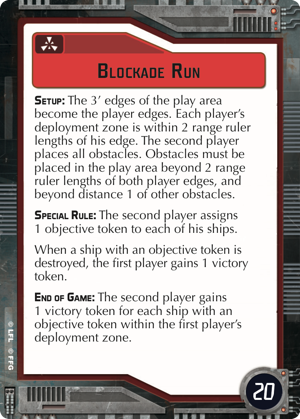
Blockade Run

Tactical: Favorable if you can leverage the narrow board.
Scoring: Modest advantage for second player.
Fun Factor: Mixed.

It looks cool. The narrow board creates exciting ISD murder corridors. But MSU fleets can sometimes just stall, then dash across for points without engaging—and that’s less fun.

Fixes:

  • Remove the station.

  • Add 2 dust fields.

  • Let Second Player discard their ship’s objective token to resolve Evade, even if they don’t have the defense token.

Verdict: Borderline playable already—but there are better options TBH. Dust helps. A flexible, defensive mechanic helps more. But will these changes make it a "good" objective in terms of the above criteria or just annoying for First Player?


Close-Range Intel Scan (CRIS)

Tactical: Dust fields in play, no other 2nd player advantage.
Scoring: Modest advantage for second player.
Play Rate: Rare.

This one saw some use back in the day, mostly with accuracy generators. It's a pure scoring objective, no tactical advantage outside the dust fields. It hasn’t aged well, I think. And Quad Turbos got turned into a Mod, which didn't help.

Fix:

  • Allow squadron attacks to generate tokens/points.

This gives squad-centric fleets a thematic, useful red objective to round out their suite. I'm sure someone will find this to be potentially troublesome, but I mean, who doesn't want to play this with ARCs, Ketsu, Maarekdon, Gold Squadron, etc.?

Verdict: Not far off. This one tweak puts it back on the table (maybe) by making it a viable pick for squad-centric fleets.


Station Assault

Tactical: Come at me burh + healing potential.
Scoring: Modest advantage for second player.
Play Rate: Near zero

It’s quirky and hard to interact with—but not impossible to fix. It plays a bit like Contested Outpost, but with two stations that can heal you. This is good. On the other hand, the stations are squishy and can easily be picked off in so many ways. Not good.

Ideas:

  • Add 2 dust fields with some form of placement restrictions to prevent fortress setups.

  • After setup, Second Player chooses one Armed Station (aligned to them); the other is an unaligned Unarmed Station

This gives real decision-making to both sides, while staying flavorful.

Verdict: Needs thoughtful rework, but the bones are interesting.


Targeting Beacons

Tactical: Rerolls are significant if you can get them.
Scoring: None.
Play Rate: Near zero

Letting First Player throw two tokens in the corners while Second Player tries to scrape together rerolls? No thanks, even if you were to bring multiple Strategic squadrons.

Full overhaul:

  • Players alternate placing 5 tokens beyond distance 5 of the long edges.

  • During attacks:

    • Second Player rerolls 2 dice.

    • First Player rerolls 1 die.

Now there’s a real battlefield and real decisions with counter-play options. It has some similarities with Most Wanted. The only part lacking is scoring, but the tactical stuff is pretty powerful, so that's probably fine.

Verdict: Needs a total rewrite. The current version is non-functional.


🚢 Navigation Objectives (Yellow)


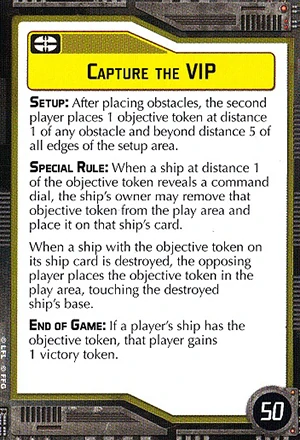
Capture the VIP

Tactical: Forces the 1st player to chase.
Scoring: Modest.
Play Rate: Solid fallback pick.

This is a safe, effective objective, the kind you take when there are no better options, and that's fine—but let's consider what can be done to make it slightly more attractive.

Fixes:

  • Increase token value to 60 or 75 points.

  • Ban flotillas from carrying it.

  • Possibly ban Strategic movement of the token.

  • Add 2 dust fields for thematic and tactical flair.

Verdict: Still good. Deserves a small bump to stay relevant.


Fighter Ambush


Tactical: Bad deployment penalty.
Scoring: Potentially high, can be flipped by those 1st players who pick it.
Play Rate: Very Rare

This one has two issues: squad-heavy lists have paid a premium for their deployment advantage, and giving that up can be pretty bad. Secondly, the only opponents that will choose this one are those that can flip it, or fight you to a point where you gain zero points from it.

Fixes:

  • Instead of setting aside squadrons, Second Player’s squads gain Scout.

  • First Player’s ships receive 1 squadron aid token each at the start of Round 1 (Maybe also round 2, but that may be too harsh).

Now this feels balanced and offers squad-centric fleets a fair fight.

Verdict: A few tweaks away from being a viable option.


Jamming Barrier

Tactical: Decent if leveraged correctly.
Scoring: None.
Play Rate: Rare.

A weird but flavorful card that could shine with more interaction. I've seen this objective leverage to some effect, so it's not hopeless by any means. But still, let's see if we can make it slightly better, or at least more flexible.

Fixes:

  • At the end of each round, Second Player may:

    • Move one token up to Distance 1, or

    • Remove both tokens (drop the barrier).

  • Optional: First Player gains a CF raid token if shooting through the barrier.

Verdict: Leave it niche, but make it dynamic. This way, the second player gains a lot of tactical options. Combined with the dust fields already in play, this creates a constantly changing battlefield.


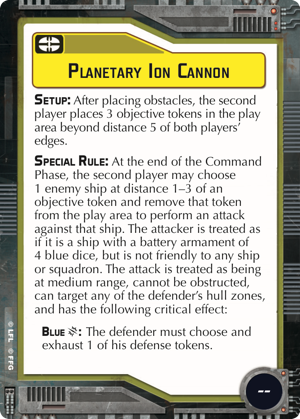
Planetary Ion Cannon (PIC)

Tactical: Strong.
Scoring: None needed.
Play Rate: A staple of yellow, but not overrepresented.

A consistent, thematic choice that punishes poor positioning. One minor fix keeps it feeling sharp.

Fix:

  • If the cannon doesn’t fire, Second Player may move one token up to Distance 1–2

Verdict: Still a top-tier objective. Minor tuning keeps it fresh.


🛡️ Defense Objectives (Blue)


Navigational Hazards

Tactical: Practically useless.
Scoring: Very modest in practice.
Play Rate: Zero.

In practice, this is a useless objective. It should be fun with all the moving parts, but only the slowest and most cumbersome ships fail to avoid the obstacles. And if the first player avoids all obstacles, the scoring advantage is zero for the second player.

It also suffers horribly from being overshadowed by other blue objectives. If you're playing Romodi, would you want THIS or Infested Fields? Yeah, thought as much.

Fix:

  • First Player must assign 1 additional command dial to each of their ships.

Now you’re adding pressure without altering the game’s physical space. This idea was lifted straight from Nebula Outskirts (but toned down a bit).

Verdict: Still jank—but fun jank, now.


Salvage Run

Tactical: Minor, forces a fight.
Scoring: Modest.
Play Rate: An alternative to Intel Sweep

Fixes:

  • Second Player chooses Nav or Repair tokens at setup.

  • Add a 5th token or increase value to 20 points.

Verdict: Still chill. Slight buff makes it a fair pick.


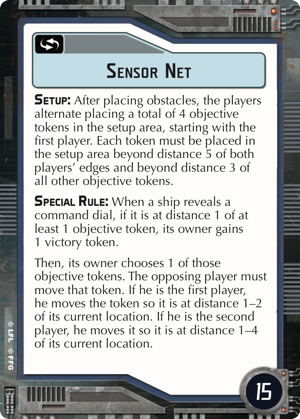
Sensor Net

Tactical: Forces a fight.
Scoring: Too much.
Legacy: Token-farming hell.

Token sweeping, Strategic abuse, and low interaction. This is the original sin of token farming hell.

Fixes:

  • Players choose between a victory token or a command token.

  • Reduce Second Player’s move range to 1–3.

  • Reduce victory token value to 10 points.

Being able to take a command token instead of points is the more interesting tweak.

Verdict: The potential for abuse is still there, but now there is a tactical/choice element to it, and the points are not as severe.


Solar Corona

Tactical: Can be significant, especially for fleets with few deployments.
Scoring: None.
Play Rate: Decent.

An example of simple design done well.

Optional spice:

  • For every accuracy icon removed by the Corona, opponent gains 10 points.

Not necessary, but could be fun.

Verdict: Still excellent. No fix needed.


🔚 Outro

The Corellian Conflict gave us some truly iconic objectives—and a few infamous ones. While not every design aged gracefully, many can be revived with relatively light tweaks. Adding dust fields for thematic consistency, reining in Strategic abuse, and offering meaningful decisions to both players are all steps toward a healthier objective pool.


🔜 What’s Next?

In Part 3, we dive into the final batch of objectives—those from Rebellion in the Rim.

We'll explore them all.

Saturday, August 9, 2025

Battle for Endor: Listbuilding pt. 1 - CIS Mar Tuuk All-ship


I've signed up for the Battle of Endor (Online Armada on TTS) and figured I need to craft a list or three... 

Haven't been playing a lot of competitive Armada these past few years, so my list-building skills are a bit rusty, but surely, I should be able to put something together!

Endor is an ARC01 event, so one of my criteria is to try out some of the new stuff. That's a sound approach to competitive listbuilding, right? RIGHT!???

Since the Quarren Gunship looks pretty interesting, I wanted to include it. And why not use the Command Frigate as well?

I came up with the MT all ship list. It's... not perfect. It has no defense against squadrons except to get in your face and smash. Except that's easier said than done against, say, a rogue ball and supporting fast ships. On the other hand, it has plenty of firepower, four threat vectors, the ability to fight at all ranges, and just enough dice fixing to fix the worst red dice have to offer. And if one ship dies, it doesn't give up too many points.

MT could potentially go on another ship, but overall, the cigar is the right spot for him. Tikkes would be fine on the flag as well, but TRC+CF tokens are very useful on this version of PF. Speaking of PF, that's a lot of long-range pew pew for only 100 points, especially when aided by IF! Same with the Quarren... super slick at 70 points but a lot of firepower.

What do you think? Is the list viable? Potentially fun to fly? Or am I completely off target here? Drop a comment and let me know!

Next time I'll take a look at a Republic list using the new Veneator, so stay tuned for part 2.

### 400 points ###

Name: Marty McTuuk

Faction: Separatists

Commander: Mar Tuuk

Version: ARC01


Assault: Opening Salvo

Defense: Hyperspace Assault

Navigation: Solar Corona


Providence Carrier (102)

• Mar Tuuk (28)

• Thermal Shields (5)

• Intensify Firepower! (6)

= 141 Points


Recusant Light Destroyer (85)

• Tikkes (2)

• Turbolaser Reroute Circuits (7)

• Patriot Fist (6)

= 100 Points


Munificent Command Frigate (74)

• Thermal Shields (5)

• Linked Turbolaser Towers (7)

• Munitions Resupply (3)

= 89 Points


Quarren Gunship (63)

• Ordnance Experts (4)

• Disposable Capacitors (3)

= 70 Points


Squadrons:

= 0 Points


Total Points: 400